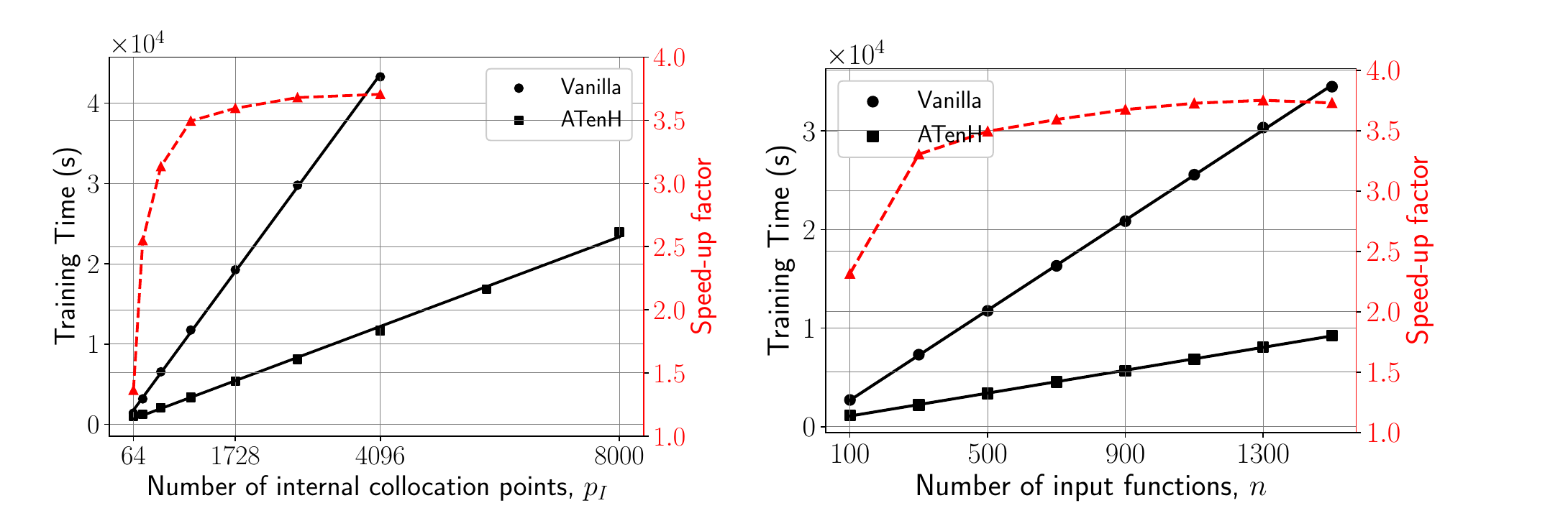
Physics-informed Deep Operator Networks learn mappings between functions, but their computational cost can be driven more by tensor construction than by the operator-learning idea itself. Banks, de Almeida and Maldonado identify redundancy in the conventional implementation: the Branch network receives the same input function at every collocation point. Their ATenH formulation evaluates the function once and reuses its encoding across the collocation set. The underlying mathematical operations remain unchanged, while the tensors entering the Branch network are smaller.
For the paper's two-dimensional linear-advection benchmark, averaged across ten independently initialized models trained for 100,000 full-batch epochs on an NVIDIA A100, mean training time decreased from 11,800 s with the conventional implementation to 3,360 s with ATenH. This corresponds to a 71.4% reduction, or a 3.49-fold speed-up. Mean relative root-mean-square error remained comparable: 2.094 ± 0.846% for the conventional model and 1.524 ± 0.513% for ATenH; these percentages are dimensionless. In three dimensions, the conventional model exceeded available GPU memory, while ATenH completed in about 39 h with a mean relative error of 5.438 ± 1.108%. The paper's 580-fold figure for this case is a theoretical cost-model prediction, not a measured speed-up.
This result matters because avoidable tensor replication can determine whether a scientific-learning model fits in memory. It does not demonstrate universal acceleration. The experiments cover linear advection, use one GPU class, and require all output functions in a batch to have the same number of collocation points. Measured gains also fall below theoretical estimates because the model omits data movement, memory allocation, automatic-differentiation graph construction, activation evaluation and optimizer overhead.
Proposed ten-business-day pilot
This proposed study would reproduce and extend the results. It has not been conducted and claims neither a new result nor a guaranteed manuscript.
- Days 1–2 — freeze inputs and equivalence tests. Reimplement the conventional and ATenH tensor paths in the same framework. Use one versioned two-dimensional linear-advection generator, with identical input functions, sensors, collocation points, network widths, optimizers and seeds. Before training, compare forward outputs and parameter gradients at matched weights to test mathematical equivalence numerically.
- Days 3–4 — establish the baseline. Train both implementations using five fixed seeds on the same GPU and within the same wall-clock budget. Record time per epoch, peak allocated memory, optimizer steps, loss histories and held-out mean relative root-mean-square error. Treat out-of-memory events as results rather than silently reducing the batch.
- Days 5–6 — reproduce the scaling claim. Vary the number of internal collocation points and input functions separately, holding the other quantities fixed. Compare the measured slope and speed-up with the paper's linear-scaling prediction, and include profiler traces for tensor creation, Branch evaluation and automatic differentiation.
- Days 7–8 — perform independent validation. Repeat the frozen benchmark on a second GPU or in a separate implementation environment, without retuning. Add one declared nonlinear transport case as an external validity check, keeping it separate from the paper reproduction. Report predictive error, wall time, peak memory and failure rate, with confidence intervals across seeds.
- Days 9–10 — package the evidence. Deliver a container or locked environment, configuration files, seeds, raw timing and memory logs, profiler traces, tests, plotting scripts and a manuscript-ready table distinguishing reproduced paper claims from the nonlinear extension. A single documented command should regenerate every reported metric and figure.
Further work beyond the pilot would depend on numerical equivalence, reproducible memory savings, stable held-out error, and evidence that the gain persists in a nonlinear case and a second execution environment.
