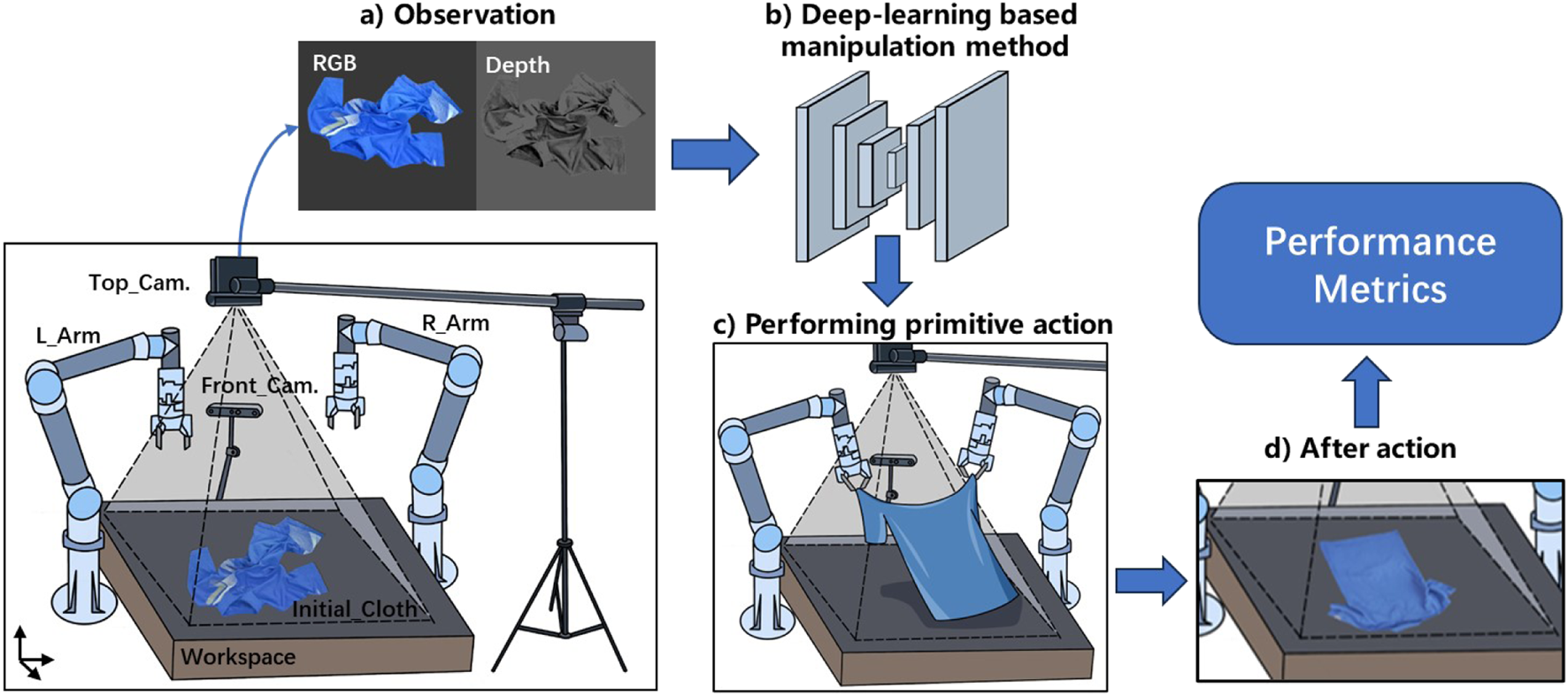
Real‑world robotic manipulation remains challenging, especially with deformable objects such as cloth — central to apparel automation, domestic robotics, and flexible manufacturing. A new open‑access systematic review synthesizes 41 recent deep learning approaches to cloth unfolding, folding, and manipulation in robotics, organizing them into six learning + control paradigms.
The review highlights how perception‑guided heuristics, predictive state representations, reinforcement learning with primitive actions, and large‑model‑assisted planning contribute to improved generalization across cloth variations, dataset requirements, and simulation‑to‑reality gaps.
Early implementation of the review’s insights can accelerate deployment in domain‑specific robots: • Deploy perception‑guided heuristics using real sensor streams for initial folding tasks. • Benchmark task generalization using different fabric types to gauge deep learning improvements over traditional methods. • Introduce predictive state models to improve adaptability in new environments.
Such advances help bridge the gap between research and practical automation for deformable object handling.