Replacing a representative-volume-element solve with a neural constitutive law can make multiscale finite-element analysis practical, but interpolation error is not the only concern. A learned hyperelastic energy may fit stress data accurately yet lose the curvature and growth properties needed for a structural solve when deformation moves beyond the sampled domain. This paper asks whether an anisotropic surrogate can learn a microstructure’s useful directional response while satisfying key mechanical restrictions by construction.
S. Ares de Parga and colleagues introduce paired directional features whose orientations, stretch powers, and determinant exponents are learned from representative-volume-element data. Each feature is passed to either an input-convex neural network (ICNN) or an input-convex Kolmogorov-Arnold network (ICKAN). By construction, the complete energy is objective, exactly stress-free in the reference configuration, two-dimensionally polyconvex, and subject to prescribed growth conditions; nonnegative energy is certified separately for the selected trained models. An otherwise matched unconstrained energy and three hyperreduced projection-based reduced-order models serve as references.
The controlled results show both the cost and the benefit of the constraints. On the multicavity cell, six learned paired features reduce median held-out stress error from 0.3282% to 0.0445% for the ICNN and from 0.3014% to 0.0406% for the ICKAN, relative to fixed features. The unconstrained energy is more accurate within the fitting box, reaching 0.0073% stress error. On the single-cavity cell, the selected constrained models remain near 0.6% stress error and near 0.4% displacement error in a tensile-coupon FE^2 simulation against the nested full-order reference.
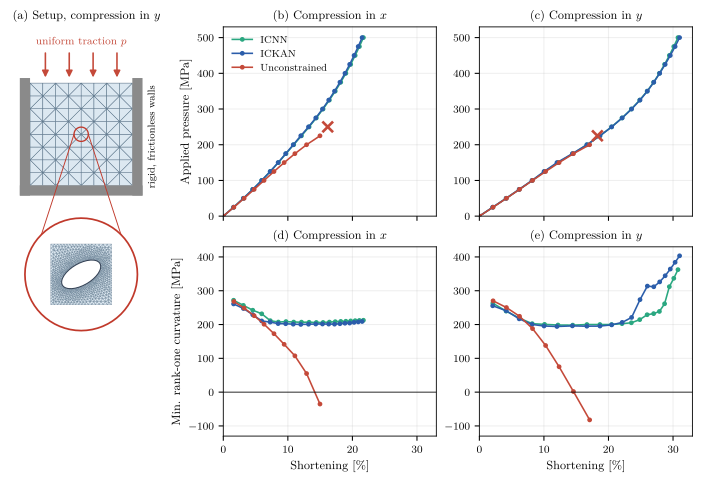
Figure 15 presents a more demanding test because it deliberately goes beyond the training domain. A 10 mm square block, meshed with 128 quadratic triangles, is compressed in 20 increments to 500 MPa, while the authors track minimum rank-one curvature over 384 Gauss points. Both constrained energies reach 500 MPa in the x and y directions, with four to nine Newton iterations per increment. The unconstrained energy fails to converge within 50 iterations at the increment to 250 MPa in x and 225 MPa in y, coinciding with its rank-one curvature becoming negative. At every sampled Gauss point and load increment, the constrained models keep minimum curvature above 194 MPa.
The engineering significance is not that constraints always improve accuracy. They do not: within the data, the unconstrained network and hyperreduced models are more accurate. Rather, the value is that admissibility is built into the architecture instead of being inferred from a finite validation set. For constitutive surrogates embedded in nonlinear solvers, preserving a solvable incremental problem under an unexpected loading path can be more important than minimizing interpolation error by another fraction of a percent.
The limitations define the scope of the result. The examples are two-dimensional, plane-strain, history-independent hyperelastic problems involving two synthetic periodic cells and two structural loadings. Polyconvexity is a sufficient restriction, not a necessary description of every homogenized material, and it does not guarantee structural uniqueness. Agreement with nested FOM-FE^2 measures error within the adopted homogenization model, rather than against an explicitly resolved physical specimen. The reported timings cover online workflows only. The authors also report that the constrained error penalty depends strongly on the microstructure and that six learned features may not suffice elsewhere. The supporting code, trained models, and data are promised for release upon publication but are not yet available in the cited arXiv version.
Proposed ten-business-day pilot
This is a proposed feasibility study, not a completed experiment, a claim of novelty, or a guarantee of publication.
- Days 1–2 — Freeze the problem and inputs. Choose one openly specified two-dimensional anisotropic hyperelastic RVE with a reproducible mesh and constituent law. Version the mesh, boundary conditions, strain convention, nondimensionalization, solver tolerances, load paths, random seeds, and exact train/validation/test split. Reserve one compression path and one rotated loading path exclusively for independent validation.
- Days 3–4 — Generate references and baselines. Run full-order periodic homogenization on the registered fitting states. Train an unconstrained energy network and a fixed-feature polyconvex baseline using the same samples, optimizer budget, precision, and seeds. Record relative stress and tangent errors in percent, energy error in percent, wall time in hours, Newton iterations, and failures.
- Days 5–6 — Add learned paired features. Train polyconvex ICNN variants with two, four, and six paired directional features. Match all non-feature hyperparameters to the baseline. Use an independent test script to verify objectivity, zero reference stress, energy nonnegativity for the selected parameters, tangent symmetry, and the documented growth conditions.
- Days 7–8 — Validate independently. Embed each surrogate in the same macroscopic finite-element driver. Run the withheld tension, compression, and rotated paths, including states outside the fitting box. Compare results with fresh full-order queries, not training outputs. Measure stress error in percent, displacement error in percent, pressure in MPa, minimum rank-one curvature in MPa, Newton iterations, convergence rate, and online time in seconds.
- Days 9–10 — Stress-test and package. Search a pre-registered grid of rank-one directions and out-of-domain deformations. Document every negative-curvature or non-convergence event, and repeat the principal metrics across at least three seeds. Deliver locked dependencies, immutable data and mesh manifests, model checkpoints, raw metrics, validation scripts, and a single command that rebuilds every table and figure.
The resulting reproducible evidence could support a later comparative study and, if the findings warrant it, a future manuscript. Without separate work, it would not establish experimental validity, three-dimensional generality, or material-history capability.
